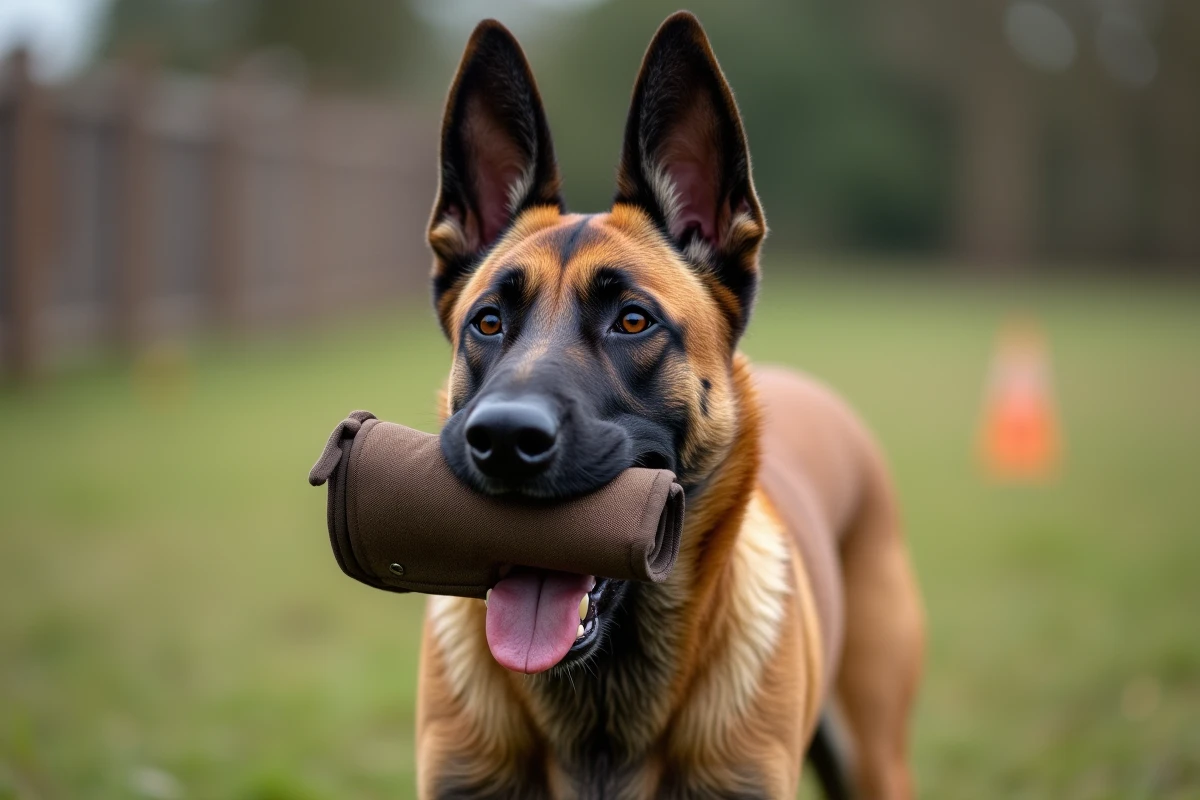
The bite force of the Malinois fuels viral rankings where each breed is assigned a number in PSI, often without a measurement protocol or verifiable source. Behind these charts shared on social media, the biomechanical reality tells a completely different story.
Biomechanics of the Malinois Bite: What the Mesocephalic Skull Implies
The Malinois has a mesocephalic skull, meaning it is neither flattened nor elongated. This morphology directly influences the geometry of the temporomandibular joint and the lever arms of the masseter and temporal muscles.
A brachycephalic skull (like a Bulldog) generates a short lever arm but high compressive force on the molars. A dolichocephalic skull (like a Greyhound) favors closing speed at the expense of power. The mesocephalic skull of the Malinois represents a functional compromise, without any particular peak power compared to other breeds of similar size.
The quality of dentition and the state of the temporomandibular joint significantly alter the actual bite force. Cervical osteoarthritis or joint pathology reduces the dog’s ability to exert maximum pressure. We regularly observe adult Malinois in the clinic whose effective bite force is well below theoretical values, simply due to undiagnosed joint pain.
Understanding the jaw pressure of the Malinois therefore requires reasoning on a case-by-case basis, integrating individual morphology, age, and the dog’s health status.
Malinois Bite Force in PSI: Why Numbers Circulate Without Protocol
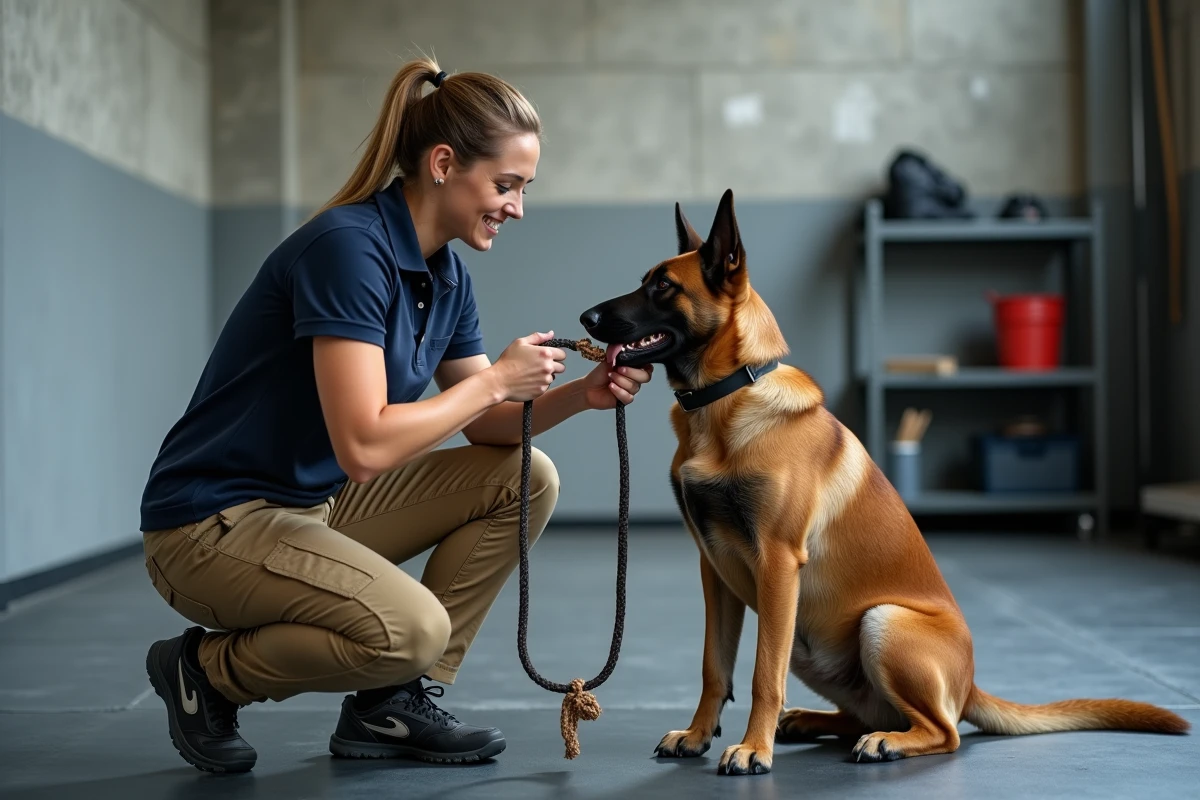
The PSI (pounds per square inch) values repeated from article to article mostly come from non-standardized measurements. Testing conditions vary significantly: the dog’s motivation, the type of sensor used, the area of the jaw engaged, and the stress level during measurement.
The bite force varies more by individual and context than by breed. A stressed Malinois in an unfamiliar environment will not bite with the same intensity as a motivated dog in a sport bite session. The same individual can produce very different values from one trial to another.
Biomechanists working on these protocols observe a significant overlap between the values obtained for the Malinois and those of other dogs of comparable size. In other words, a German Shepherd, a Rottweiler, or a Malinois of similar sizes can produce overlapping bite forces. Breed-specific rankings are more about viral marketing than scientific rigor.
Sport Biting and Real Biting: The Confusion Between Power and Commitment
In the ring, in IGP, or in intervention biting, the Malinois is selected for its reactivity, speed of commitment, and ability to maintain a grip under pressure. These qualities create an impression of raw power, but the mechanism is different.
Training modifies the quality of the bite, not the maximum power. A sport Malinois works with a full mouth, with prolonged grip duration and high stress resistance. This “full” bite distributes the force over a large dental surface, making it effective without requiring exceptional unit pressure.
The perception of power comes from several combined factors:
- The dog’s commitment, its impact speed on the sleeve or suit, which creates a kinetic shock independent of pure jaw strength
- The duration of maintenance under strain, which reflects nervous resistance rather than superior muscular capacity
- The full-mouth bite, which engages the entire dental arch instead of a superficial grip on the incisors
A dog that bites “well” in terms of work is not a dog that bites “hard” in a physical sense. This technical distinction is rarely made in mainstream content.
Severity of Malinois Bites: Factors That PSI Pressure Does Not Measure
In veterinary behavioral medicine, the damage caused by a bite depends at least as much on the area affected and the duration of the grip as on raw force. A low-pressure bite on a child’s face causes much more severe injuries than a powerful bite on a protected forearm.
The Malinois, due to its reactivity and speed of release, can inflict serious injuries not because its jaw is stronger than that of another dog of the same size, but because the bite occurs quickly, often without clear warning signals in poorly socialized individuals.
The Malinois’s reputation for aggression is fueled by its overrepresentation in security and defense jobs. This work-oriented selection produces dogs with a high drive level, whose management in a family requires early socialization and structured training. The issue is not the power of the jaw, but the bite trigger threshold in an inadequately guided dog.
Malinois in Family: Education and Socialization Rather Than Fantasy About the Jaw
Focusing the discourse on PSI distracts from the real issues of cohabitation. A well-socialized Malinois, educated consistently and whose exercise needs are met, poses no more risk than any other working shepherd.
The determining factors for family life are of a different order:
- The quality of socialization between three and twelve weeks, a critical period for tolerance to new stimuli
- The daily activity level, as an under-stimulated Malinois develops redirected behaviors (destruction, excessive play biting)
- The owner’s ability to read the dog’s discomfort signals before escalation to biting
- Regular veterinary follow-up, particularly to detect joint pain that can provoke defensive reactions
We recommend considering the Malinois as a working dog whose behavioral management takes precedence over any numerical data on jaw pressure. PSI rankings do not predict either the risk of biting, the potential severity, or compatibility with a given living environment.